top of page

Personal Blog

  • Writer: mraya99
    mraya99
  • Dec 21, 2022
  • 2 min read

In his second letter, Seneca explores the theme of wealth and the importance of living a simple, contented life. He begins by reiterating the importance of wisdom and contentment as key qualities for a happy and fulfilling life, and notes that true wealth is not measured in material possessions but rather in the quality of our relationships, the strength of our character, and the peace of mind that comes from living a simple, virtuous life.


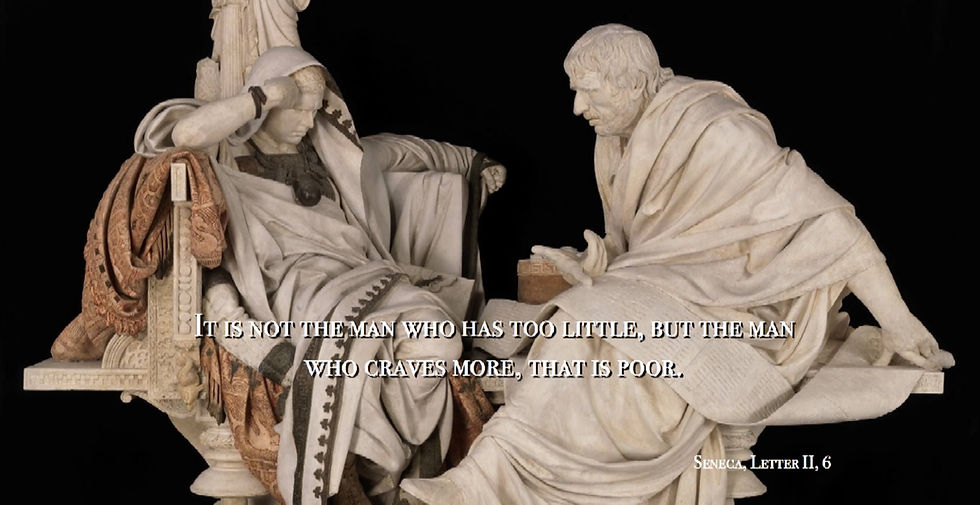
One of the key themes of Seneca's letter is the idea of contentment. He writes that contentment is the ability to be satisfied with what we have, rather than constantly striving for more, and argues that those who are content with what they have and who live simple, virtuous lives are truly rich, no matter how much or how little they possess. This idea is emphasized when Seneca writes that "it is not the man who has too little who is poor, but the one who hankers after more."


Seneca also touches on the idea of a well-ordered mind, which he defines as a mind that is at peace with itself and not constantly seeking more and more stimulation from the outside world. He writes that such a mind is content with the simple pleasures of life and does not need to constantly seek out new and expensive experiences in order to find happiness, and that it is only through a well-ordered mind that we can hope to find true contentment and fulfillment in life.


In addition to discussing the importance of contentment and a well-ordered mind, Seneca advises his correspondent to surround themselves with writers of genius, rather than those who are merely clever. He argues that true wisdom and understanding come not from clever wordplay and superficial knowledge, but from a deep, genuine understanding of the world and our place in it.


Overall, Seneca's second letter emphasizes the importance of living a simple, contented life and cultivating a well-ordered mind. He argues that true wealth is not measured in material possessions, but rather in the quality of our relationships, the strength of our character, and the peace of mind that comes from living a virtuous life. By cultivating contentment and a well-ordered mind, and by surrounding ourselves with those who are truly wise, we can hope to find true happiness and fulfillment in life.


  • Writer: mraya99
    mraya99
  • Dec 21, 2022
  • 2 min read

In his third letter on friendship, Seneca explores the nature of true friendship and the importance of cultivating and maintaining strong, meaningful relationships with others. He begins by addressing a letter that has been sent to him by a friend of the correspondent, and notes that the fact that the letter was not sent directly is a sign that the correspondent does not truly have a friend.


Seneca defines friendship as "a strong and habitual inclination in two persons to promote the good and happiness of one another," and emphasizes that it is a mutual feeling, not a one-sided affair. He notes that true friendship is based on mutual respect, trust, and a shared sense of values, and is characterized by a deep, genuine connection and a shared sense of purpose. Seneca writes that the correspondent warns him to "avoid discussing your affairs freely with him (the 'claimed' friend)" in which Seneca makes the critique that the correspondent does not in fact have a friend, which is a fair judgement based on his belief that trust is a core component of true friendships.


One of the key themes of Seneca's letter is the idea that friendships are not just about receiving, but also about giving. He writes that true friends are not those who are simply looking for someone to lean on, but rather those who are willing to offer support and assistance to their friends in times of need. This concept is further emphasized when Seneca writes that "friendship is an accord in all things, human and divine, conjoined with mutual goodwill and affection. It is steadfast and lasts as long as life."


Another important aspect of friendship that Seneca touches on is the idea of loyalty. He writes that true friends are those who stand by each other through thick and thin, and who are always there to offer support and encouragement when it is needed most. Seneca also advises against trying to deceive oneself by calling an acquaintance a friend, and notes that true friendship is founded on a deep, genuine connection that goes beyond mere words.


In conclusion, Seneca's third letter on friendship highlights the importance of cultivating and maintaining strong, meaningful relationships with others. He emphasizes the need for mutual respect, trust, and a shared sense of values, and argues that true friendship is based on a deep, genuine connection that is founded on a willingness to give and support one another.


  • Writer: mraya99
    mraya99
  • Sep 20, 2022
  • 4 min read

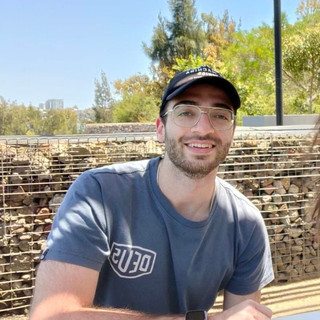
Hey there! I'm Mark, a Postgrad student studying Information Technology (IT) at The University of New South Wales (UNSW). I have previously completed a bachelor's degree of Mechanical Engineering (Honours) at The University of Sydney (USyd). To the left, you can see a photo of me from my graduation day for my bachelor's degree. Maybe another year or two and I'll have some photos when I (hopefully) graduate from my master's degree too.


This blog post is just a short introduction about me and my website. To add more to my self-introduction, I'll talk about my inspiration for moving into IT. In my first year of uni, I completed a programming unit which was my first ever contact with the world of coding. Fast forward a few years to my thesis, which I completed to graduate with honours. My thesis, titled "Using Numerical Reactors to Understand Autoignition", was the next time I had immersed myself in programming, and over the year, I slowly started to realise that I seriously find coding interesting and that I may have picked the wrong degree to begin with.


In fact, it's quite fortunate that I stumbled upon coding in my thesis, because initially, my report was supposed to involve physical experiments and results, however, due to the COVID-19 pandemic and the plethora of restrictions placed on in-person activities, I was limited to a strictly coding thesis. So, fortunately, the pandemic led me to making my serendipitous discovery that I like coding, which has further led me to pursuing my passion by enrolling into IT as a postgrad. Aaaand this is where I'm at now. It's been two thirds of a year (or two trimesters) and I've enjoyed every second of it. It's definitely a challenge, but then again, what uni degree isn't? In saying that, this is a challenge that I am prepared for, and so I'm strapping myself in for the next 1-2 years.


Now, what are my plans with this website and what are my plans in general? Well, regarding the website, I'm not entirely sure. I at least know that I will definitely use this platform to display my coding projects. As for the blog, maybe I will check in every now and then, posting updates on my progress with my degree, and maybe I might also discuss some interesting findings through any of my research (side note: I plan on completing a PhD after the master's degree and so I'm taking it upon myself to read research papers every now and then). Regardless, I think the main purpose of this site is to act as a portfolio to 'sell myself'. The plan is that my prospective employers may use this website to learn more about myself, and if all goes well, at that point, I would have added a wide range of projects to this site, which should help me become more employable.


Regarding my general plans, over the next year or two, the master's degree will be my main focus. If I average 2.5 units per trimester until the end of 2024. I should have completed 14 out of the required 16 units of the degree (I have already done 4 units and there are 4 trimesters left till the end of 2024, so the calculation is (4 + 4 * 2.5 = 10)). Some extracurricular stuff I plan on completing are:

  • At least one LeetCode challenge per day (the daily challenge minimum + any mote I have time for).

  • A variety of personal or group projects I can work on during my downtime.

  • Possibly, some uni related projects; UNSW is always advertising student led group projects that we need to apply for. I might try to apply for 2024.

Currently, I'm on a 15-day streak for the LeetCode daily challenges and in total I've done 37 problems all up just because I've been on uni break for the past 2 weeks. I'm also working on a simple calculator that outputs your percentage result required of the final exam/assignment to obtain each grade (P, C, D and HD). That leaves the uni related project, which I plan on applying for at some point during this week.


Otherwise, another goal that's on my radar but not absolutely critical at the moment is to score an internship or job at some IT company. The reason why I say 'not absolutely critical' is because I know I am currently not at the required skill/knowledge level to excel in these roles. I still have a long way to go and a lot to learn. By achieving the goals I have outlined above, I will get to where I need to be, in terms of skill and knowledge, in no time.


Anyway, to wrap up this first post, I'll just reiterate that I am extremely excited to see where this degree will take me. The world of computer science covers a variety of interesting topics that are just waiting to be explored, and this degree is going to help introduce me to this world. Once complete, who knows where life will take me, I just know it will be somewhere I definitely enjoy.

Contact
Information

University of New South Wales

Master of IT

0431 256 566

  • LinkedIn

Thanks for submitting!

©2023 by Mark Raya. Proudly created with Wix.com

bottom of page